
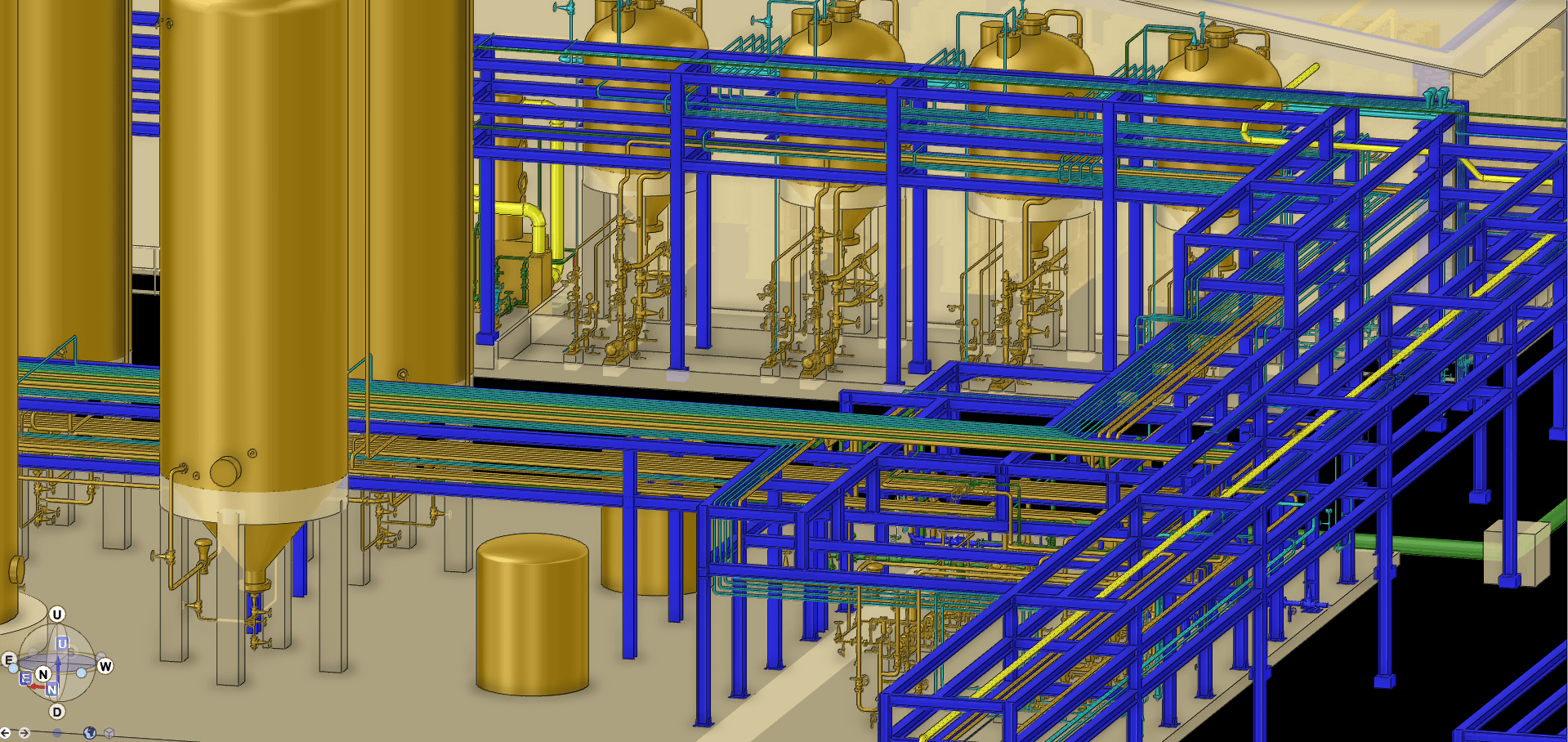
Veolia is intending to build a new hazardous waste treatment facility (defined hereafter as the “Facility”). The Facility will be used for the incineration, fixation & stabilization, microbiological treatment, evaporation, physical, chemical treatment and disposal of the various wastes that Veolia will be permitted to collect.


The whole factory
The Facility will treat a variety of hazardous wastes collected by Veolia from its customers in the Thai Nguyen region. The Facility is to provide a reliable, efficient range of recovery, treatment and disposal services for hazardous wastes which minimises risk, complies with health, safety and environmental regulations and meets legislative requirements.
As seen, the entire factory is built in 3D model form, by PEMOSE design engineers, investors and construction contractors can easily refer and adjust each individual items based on that, minimizing errors when going into construction.
The Facility to be constructed by the Employer will principally comprise of:

PCO, PCI, BIO, UTILITY… area.


PCI & Filter Press area
- Physical Chemical Treatment (PCI & PCO) – The PCI system unit handles inorganic waste which includes wastes containing acid, alkali, heavy metals, cyanides etc. using oxidation, reduction, or neutralization process. Treatment is performed on a batch basis in a reactor. Sludge cake and effluent are produced as a result of the reaction after the filter press. The sludge cake will be sent to the stabilization unit for further treatment before it is disposed of. The PCO system separates oily wastewater into oil for the HTI and wastewater for the PCI or biological treatment unit (BIO). Steam generated by the HTI is utilized in this system.


High Temperature Incineration area
- High Temperature Incineration (HTI) – Organic wastes will be destroyed through the incineration process. The rotary kiln provides the Employer with operational flexibility as it can handle liquid waste, sludges and solid waste. High temperature and adequate residence time ensure the complete destruction of all organic materials in the waste. Slag produced from the rotary kiln is taken to the stabilization unit for further treatment. The flue gases go through a boiler where heat is recovered from the gas itself to produce steam and treated in the subsequent flue gas treatment system before being discharged through a stack into the atmosphere. Fly ashes produced from the boiler and from the flue gas treatment system, are also sent to stabilization unit for further treatment. The steam generated from the boiler is used to feed a steam turbine coupled with a generator which produces electricity.


Tank Farm area
- Tank Farm Organics (TFO) – Organic liquid wastes after sorting, are decanted and blended in the tank farm prior to feeding the incinerator. Oil recovered is also stored and used as a supplementary fuel in the incinerator. All tanks in the tank farm shall be nitrogen blanketed to minimize the hazards associated with flammable liquids stored in each tank. All tanks shall also be equipped with breather valves to prevent excessive vacuum / pressure buildup in the tanks, and an emergency relief vent for emergency venting during fire.
- And many other small items…
=> The entire factory is built in 3D model form, by PEMOSE design engineers, investors and construction contractors can easily refer and adjust each individual items based on that, minimizing errors when going into construction.

 Login with Google
Itís difficult to find experienced people for this topic, but you seem like you know what youíre talking about! Thanks
May I simply say what a comfort to discover somebody who genuinely knows what they are talking about over the internet. You actually understand how to bring a problem to light and make it important. More people ought to check this out and understand this side of the story. I cant believe you arent more popular because you surely possess the gift.